When buying a cooler, checking out reviews is common practice to be an informed buyer. However after purchasing the product the consumer may find that the results they are not comparable to that of those found in the review. There are several reasons for this such as different case, fans, thermal paste etc. One overlooked variable is air density.
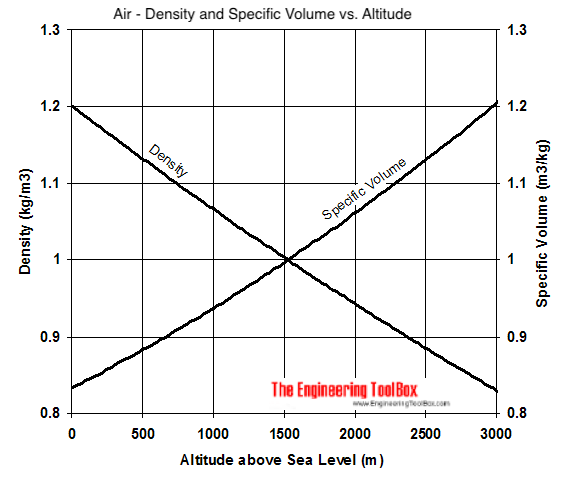
Air density is really overlooked for a simple reason: no one thinks about it. In actuality it is very important. Take a scenario of reviewer A and reviewer B. Reviewer A tests at sea level where the density of air is at its practical max. Reviewer B tests at an elevation of 1000m. This would be 1.2kg/m3 for A and ~1.06kg/m3 for B creating a difference of 13% mass for A. Reviewer A will have more air particles to work with when transfer heat to the air, therefore giving them better numbers. For a more practical elevation example this would be Vancouver at sea level and Calgary at ~1000m above sea level. It is also important to note that the mass flow rate in this scenario would be ~13% greater for Vancouver. After all there is 13% more particles that can carry away the energy. So the question becomes why does this not necessarily show up in results?
The basic formula for convection is Q=hAΔT where,
Q=Watt, h=transfer coefficient in W/m2 K and ΔT=Kelvin.
Nowhere in the convection formula does the mass flow rate appear hence it not considered. It also important to note that unless a system in passively cooled, forced convection is the only one that matters. This is especially true as in the case of a computer, fans push air in specific directions making natural hot air rising, irrelevant. Also the main driver for heat transfer when testing radiators and heat sinks is the ΔT. With ΔT even when reviewers test at the same temperature it is really only valid for the elevation they are testing at and should not be compared with other reviewers. The area and coefficient are constants and properties of the product being tested and adjusting them would no longer represent the product the consumer would receiving.
Sources:
[1]. Air – Altitude, Density and Specific Volume. (n.d.). Retrieved June 19, 2019, from https://www.engineeringtoolbox.com/air-altitude-density-volume-d_195.html [1].

 Good Enough For Practical Purposes